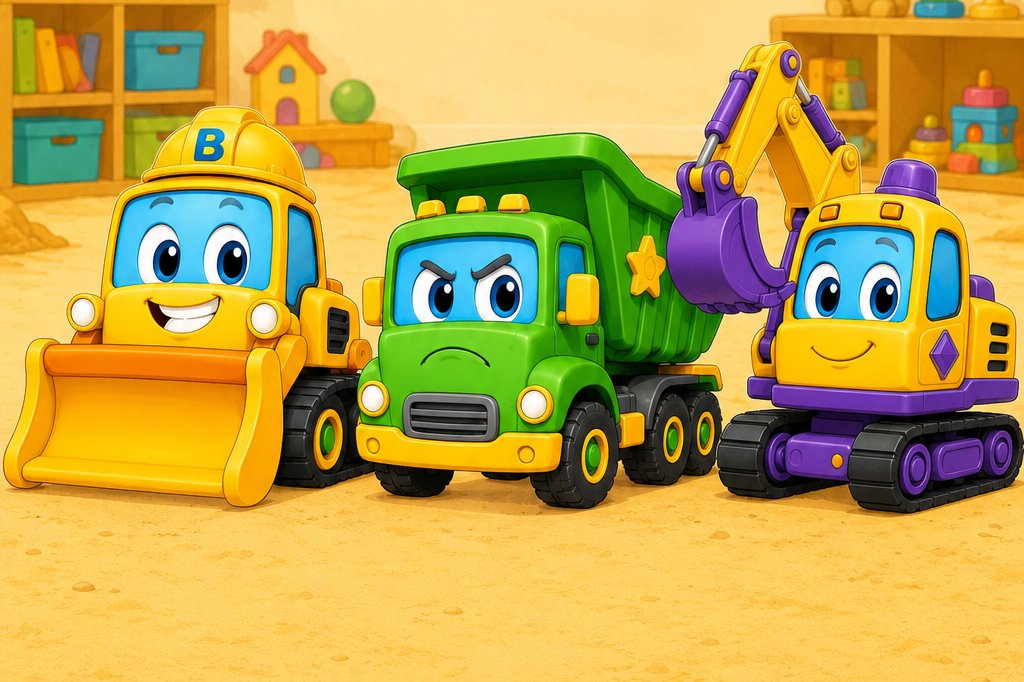
Your toddler cannot always tell you what is wrong. They can feel it, big and loud and all at once, but the words are not there yet. A feelings chart gives them the words.
Naming a feeling is the first step to handling it. When a child can point and say "frustrated" instead of hitting the floor, something important just happened in their brain. They put a little space between the feeling and what they do about it. That space is where all the calming down eventually lives.
The trick with toddlers is that a chart full of unfamiliar faces does not stick. But a chart with trucks they already love does. Below is a simple five-feeling chart using the Tiny Titans crew, plus the exact words to use for each one. You can read it on the screen, or grab the free printable version at the end and put it on the fridge.
The feelings chart
Five feelings is plenty for a toddler. Start here, point to the truck that matches how your child looks, and name it out loud. Over time they will start pointing on their own.
How to actually use it
A chart on the wall does nothing by itself. It works when you bring it into ordinary moments, and the calm ones matter more than the stormy ones.
Name feelings when things are fine. Point to Benny at breakfast and say "I feel happy this morning, like Benny." When you name feelings during calm times, the chart becomes familiar, so it is ready when a big feeling actually hits.
Name your own feelings too. "I am feeling a little frustrated that we are running late, so I am going to take a big truck breath." Toddlers learn emotional words by hearing you use them about yourself, not just about them.
Point, do not quiz. Skip "what feeling is this?" Just narrate. "You wanted the blue cup and you got the red one. That looks frustrating, like Danny when his load is stuck." You are handing them the word, not testing them on it.
Never rush to the happy truck. The goal is not to get your child back to Benny as fast as possible. All five feelings are allowed. A child who is told their sad and frustrated feelings are welcome learns that feelings are safe, and that is what actually builds calm over time.
Get the printable feelings chart
A print-at-home feelings chart with the Tiny Titans crew, plus coloring and activity pages. Put it on the fridge and point to it together.
Get the Free Printable Pack →What each feeling needs from you
Naming is step one. Here is the short version of what helps once the feeling has a name.
Happy and excited need to be shared. Get down on the floor and be happy with them. Excited especially needs a body outlet, so let them run, jump, or haul something heavy before you expect them to sit still.
Frustrated needs a small amount of help and a lot of patience. Resist fixing it instantly. "That is tricky. Do you want to try again, or should we do it together?" gives them a way through without taking over.
Sad needs closeness, not cheering up. Sit near them. A quiet "I am here" does more than a dozen reasons why they should feel better.
Calm needs to be noticed out loud so they learn what it feels like. "Your body is calm right now. That feels nice, doesn't it?" helps them recognize the state they will one day learn to return to on their own.
Why we build this into trucks
At Tiny Titans, every character quietly carries a feeling a child needs to meet. Benny is the spark of "maybe I can." Danny is the quiet worry of "does my part even matter," and the relief of learning that it does. Ellie is the wide-open wonder of "there is still more to find out."
We do it this way on purpose. A feeling is a big, invisible thing for a two year old. A truck is something they can hold. When the feeling rides in on a friendly character they already love, it stops being scary and starts being something they can talk about. That is the whole idea behind the crew, and behind this little chart.
Big jobs on the outside, big feelings on the inside, and a grown-up nearby who gets it.
Quick questions from parents
What age is a feelings chart good for?
Around two to five works well. Younger toddlers will mostly hear you name feelings. Closer to four and five, many kids start pointing to the chart and naming feelings themselves. Both are exactly right.
My child ignores the chart. Am I doing it wrong?
Not at all. The chart works through you using it, not through your child studying it. Keep naming feelings out loud in everyday moments and it slowly sinks in. This is a long, quiet project, not a quick fix.
Should I use it during a meltdown?
Gently, and mostly as the storm fades. In the thick of a meltdown your calm presence matters most. As they come back to you, pointing to the frustrated truck and naming it can help them feel understood.
Every feeling is allowed here. That is not just a nice idea. It is how children learn that big emotions are safe to have, which is the ground all self-control grows from.
Meet the crew on the Meet the Crew page, or grab the free printable feelings chart and put it somewhere your little builder can point to it.